
THERE ARE many things to stop and wonder at in The Great Trees of Dorset, including the fact that the huge yew tree in Broadwindsor churchyard may be more than 2,000 years old… Which would take us back to the Roman invasions of Dorset. Start thinking about that, and it’s impossible not also to start thinking about the yew as some kind of historic personage. The oldest living thing in Dorset, perhaps? If only it could speak! What changes it must have seen and felt! What stories it could tell!
The authors of this book definitely think in this way. Their words drift off towards personification, as if trees really were people. Discussing the changes wrought in the wake of the Dissolution of the Monasteries in the 1530s and the Civil War a century later, Pollard and Brawn (what a great muscular pair of names!) note: “There were certainly winners and losers for Dorset’s trees throughout this period…” and you think, what a genuinely charming idea it is, to tell the story of Dorset from the point of view of its trees, and, what a pity it is there aren’t more old trees left. Really old oaks, say, with large girths and mossy serpentine branches. Pollard and Brawn write: “We… probably have about 1000 veteran oaks, of whom [note that whom!] fewer than 200 are truly ancient. Even this may well be a hopeful estimate. This is an extremely low number and we should ask ourselves: how worried would we be if there were less than 200 individuals left of an orchid species?” One of the greatest individuals left is Billy Wilkins, who (they’ve got me at it now) lives in Melbury Park near Evershot, not far from the A37. His girth is 11.6 metres.
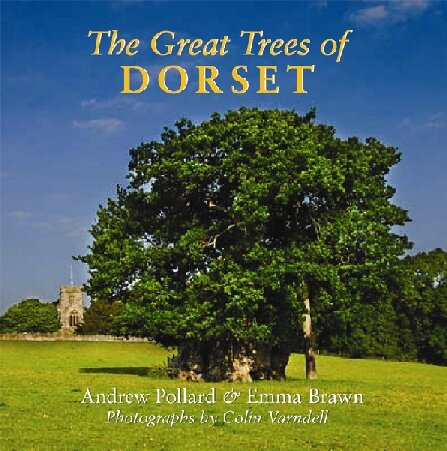
It’s to celebrate trees like Billy, and to stimulate interest in the welfare of Dorset’s veteran trees, that The Great Trees has been published. Pollard and Brawn both work for the Dorset Wildlife Trust, and their book grows out of the extensive research they’ve done in recent years for the county’s Greenwood Trees Project. The aim of this project, supported by the Heritage Lottery Fund, is to understand, celebrate and conserve Dorset’s great trees (past, present and future). Poems, songs, and pictures by schoolchildren feature throughout the book and reflect public involvement in the Greenwood scheme. Hundreds of fibrous roots have fed the authors and it shows. Leaf through their book and memorable details abound.
Did you know, for example, that the first recorded reference to children playing conkers isn’t until 1848? Did children really not play conkers before then? (Maybe so, because the horse chestnut is not a native tree; it dates back in Dorset about 220 years…) Or that cider in Dorset is first mentioned as “cisera” at Shaftesbury Abbey in 1291? Or that Stag beetle larvae feed inside deadwood for up to seven years before emerging as adults? Or that the Scot’s pines atop Colmers Hill near Bridport were planted during the First World War? Or that – best of all – one oak tree (pictured below) was once a beershop?
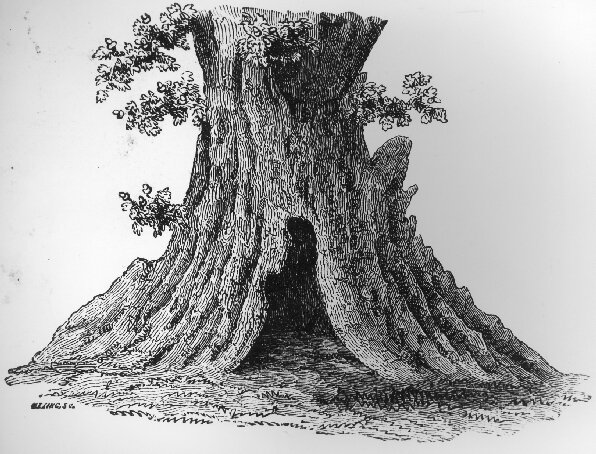
Blandford Forum’s Damory Oak was “used as an alehouse during the Civil War and up until the Restoration in 1660. It had a main apartment of 4.9 metres (16 foot) in length with a small bar in an alcove. In 1731 a fire destroyed Blandford and as a consequence two homeless families found themselves taking up residency within the tree. Sadly, the tree came to an unsympathetic end in 1755 when it was felled and sold for fuel wood, fetching £14. It is thought at the time it was sold it was a colossal 20.7 metres (68 foot) in circumference.”
These days, Brawn and Pollard report, many of Dorset’s veteran trees are looked after extremely well, particularly on the county’s big estates. But “a good number of important trees” are also said to be suffering through “a whole host of threats ranging from disease and pollution to inappropriate tree surgery, premature felling, a tendency to unnecessarily remove deadwood, and compaction around the roots from grazing animals”. And who knows what might happen as the climate changes in the future? It’s a big question, because ancient trees are fantastic habitats for wildlife, for bats, birds, fungi, lichens, mosses, ferns and invertebrates. Cob web beetle larvae, for example, are found only on ancient trees. They feed on left over meals of spiders that live on ancient trees. Brawn and Pollard pin their hopes on better understanding: “If these trees are better understood by all concerned, nurtured and celebrated they will stand a far better chance of surviving for future generations to enjoy.” They also hope that people will be inspired to nurture future generations of veteran and ancient trees.
The Great Trees of Dorset has very few weak areas. The section on birds has some lovely shots of woodpeckers but the text is rather uninspired; it’s not exactly a secret, is it, that “Many birds are commonly known to use trees…” And I would have liked to see a bit more about the old forests of Dorset, picking up perhaps on the fascinating investigative chapter about Blackmoor forest, between Cerne Abbas and Sherborne, in Oliver Rackham’s volume on Woodlands in Collins’ New Naturalists series. Academics – led by the recently-retired Professor John (Jack) Langton of St John’s College, Oxford, who used to have a house in Burton Bradstock – are also looking afresh at the legal history of forests and chases and the activities of their inhabitants. These days, we tend to think: Robin Hood, outlaws, merry men… There’s much, much more to forests than that kind of Saturday-night TV fantasy, and reflecting that would have given this book an extra dimension. But you can’t have everything. The Great Trees of Dorset has lots of excellent illustrations, including atmospheric photographs by Colin Varndell that make you wish you could go to Lewesdon Hill and Powerstock Common right now. So, if you’re interested in the trees, wildlife, or history of Dorset, this is a book you should buy, and at £9.95 for a full-colour paperback, it’s cheap. The hardback is also very competitively priced, oh, and all royalties go to Dorset Wildlife Trust.
* The images accompanying this review are reproduced by kind permission of the Dovecote Press, who remain the copyright holders.
Related posts:


Jane - Dorset Wildlife Trust
25/11/2009 at 2:19 PM
Thanks for your brilliant independent review! If any of your readers would like to buy a copy of the book, it can be purchased from http://www.dorsetwildlifetrust.org.uk/great-trees-of-dorset
All royalties from sales of the book come to Dorset Wildlife Trust to help us with our conservation work in Dorset.